VISI 5 Axis Toolpath
Efficient Multi-Axis Toolpaths with Advanced Collision Detection
GET MORE INFORMATON & A FREE TRIAL
Advanced Technology for the Mold and Die Maker
5 axis machining was once considered the exclusive domain of aerospace and automotive manufacturing — but the advantages it offers are now being widely adopted in the mold and die sector. VISI Machining 5 Axis gives operators a productive solution for generating highly efficient toolpaths with advanced collision control, purpose-built for the most complex 3D data your shop encounters.
Features at a Glance
- Extensive CAD interfaces
- 3D to 5 axis toolpath conversion
- Continuous 5 axis roughing and finishing
- 3+2 positional machining
- Multiple tool tilting options
- Full gouge protection
- Optimized toolpath movement
- Kinematic simulation
- Customizable post processors
- HTML and XLS report output
CAD Interfaces
Extensive Range of CAD Interfaces
VISI works directly with Parasolid, IGES, CATIA, Creo, UG-NX, STEP, SolidWorks, Solid Edge, Inventor, ACIS, DXF, DWG, JT Open, STL, and VDA files. The broad translator library ensures your team can work with data from virtually any supplier. For complex 5 axis programming, geometry often needs to be adjusted before machining can begin — and VISI's hybrid modeling environment makes it straightforward to manipulate and prepare even the most demanding customer CAD data quickly and accurately.
Machining Strategies
Deep Cavity and Core Machining
Complex molds frequently contain deep cavity areas and tight radii that require small diameter tooling. Conventionally, this would mean using tool extensions or longer tools — increasing the risk of deflection and compromising surface finish. By approaching these areas from a different angle, the cutting head can be lowered and collision detection automatically tilts the tool and holder clear of the workpiece. The key advantage of this approach is the ability to use shorter tools, which increases rigidity, reduces vibration and deflection, and enables higher cutting speeds — ultimately extending tool life and improving surface finish. In shallower areas, larger bull nose cutters with a small lag angle can be used to reduce the number of passes required and further improve surface finish.
3D to 5 Axis Conversion
All 3D toolpaths can be converted to 5 axis operations, dramatically expanding the range of available strategies for any machining scenario. This approach applies high speed machining techniques directly to 5 axis toolpaths. The 3D to 5 axis conversion uses intelligent collision detection and only tilts away from the part when required — keeping the toolpath as efficient as possible. This semi-automatic approach significantly speeds up programming and shortens the learning curve for operators new to 5 axis work.
Turbine and Blisk Machining
Turbine and blisk machining is typically performed using 4 axis operations. Rough machining can be accomplished using several methods — including plunge roughing — but turn milling is generally the most effective approach. Turn milling delivers the highest chip volumes per minute, consistent tool engagement, a balanced spindle load, and smooth continuous movement in all 5 axes — minimizing reciprocating motion in the fixturing system. Finishing is the most critical phase of the process, and a continuous spiral toolpath along the part is required to achieve the surface finish these components demand. The goal is always a uniform level of residual material across the entire part, achieved through multiple semi-finishing operations if necessary. Careful tool selection for finishing is essential, and by allowing larger tools while offsetting in one axis, more of the tool remains in contact with the part — reducing cusp height and improving surface finish.
Impeller Machining
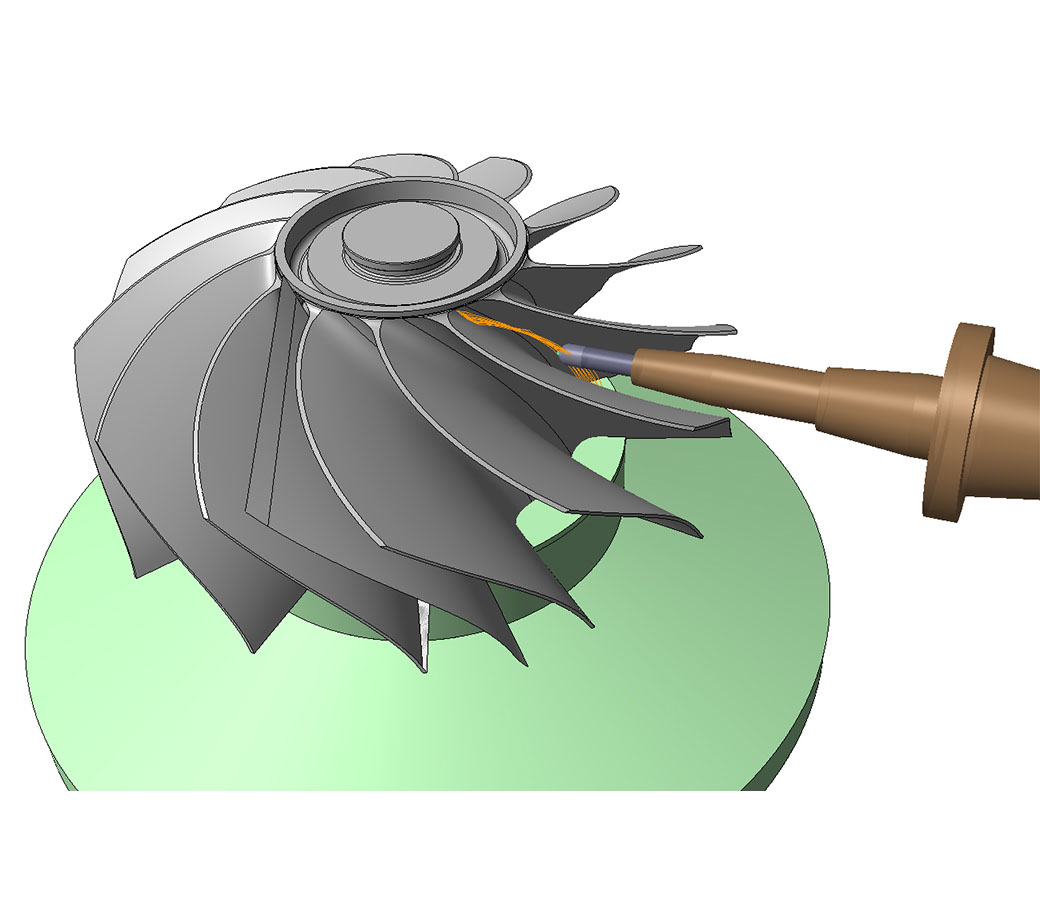
VISI provides all the tools needed for successful 5 axis impeller machining. High surface quality requirements, confined spaces, and the rotational angular motion of the axis make impeller machining one of the most demanding 5 axis tasks. VISI generates each toolpath with an even coordinate distribution, sending smooth and efficient CNC code to the machine control to minimize unnecessary vibration and reduce the impact on thin rib geometry. Surface finish is a critical requirement for impeller finishing operations, and any surface marks can be eliminated through smooth axis movements.
Positional Machining
Positional (3+2) machining allows both 2D and 3D toolpaths to be used at a fixed angle. The traditional benefit is the elimination of multiple setups — automatically orienting the head to the correct position significantly reduces machining time and the need for multiple fixtures. Like continuous 5 axis machining, positional machining also enables the machining of undercuts and allows the use of shorter cutters for improved rigidity and surface finish.
Trimming
5 axis trimming is widely used in the automotive and vacuum forming industries for groove milling and boundary trimming. For this strategy, the tool position is calculated normal to the face direction along a drive curve. Synchronization curves can be used for additional control over tool movement in local areas. Direction changes are most extreme with this type of strategy, making collision detection and toolpath simulation particularly valuable tools for verifying the program before it reaches the machine.
Safe Machining
Collision Control
Even the smallest cutter movement can result in large axis displacements on a 5 axis machine, as each motion is amplified through the tool, holder, and spindle. When a potential collision is detected, VISI provides multiple avoidance methods using smooth axis movements. Collision avoidance strategies include cutter retraction along the tool axis, tool tilting for holder clearance, and pulling the tool away from the workpiece in a defined direction. In addition to automatic avoidance, rotation axis travel can be restricted to user-defined limits to prevent spindle over-travel.
Configurable Post Processors and Setup Sheets
An extensive post processor library covers most machine tools, and every post processor is fully configurable to match individual requirements. Canned cycles for drilling and boring, subroutines, and cutter compensation can be output alongside 3+2 and full 5 axis CNC code for shop floor use. Custom post processors can be written for complex or one-off machine tools. Setup sheets are automatically generated with datum position, tooling, cycle times, and cutting envelope information, and can be tailored to each user's needs and output as HTML or XLS files.
Kinematic Simulation
Toolpath verification runs against the actual machine dimensions and travel limits using kinematic simulation, including the motion display of all rotational and linear axes. Cutting tools, holders, jigs, and fixtures are all included in the check. Any gouge detected between the toolpath and the stock, tool, or any other machine component is graphically highlighted. A comprehensive library of tested 3, 4, and 5 axis machines is available, and Hexagon engineers can assist with building kinematic models for custom or unique machine configurations.